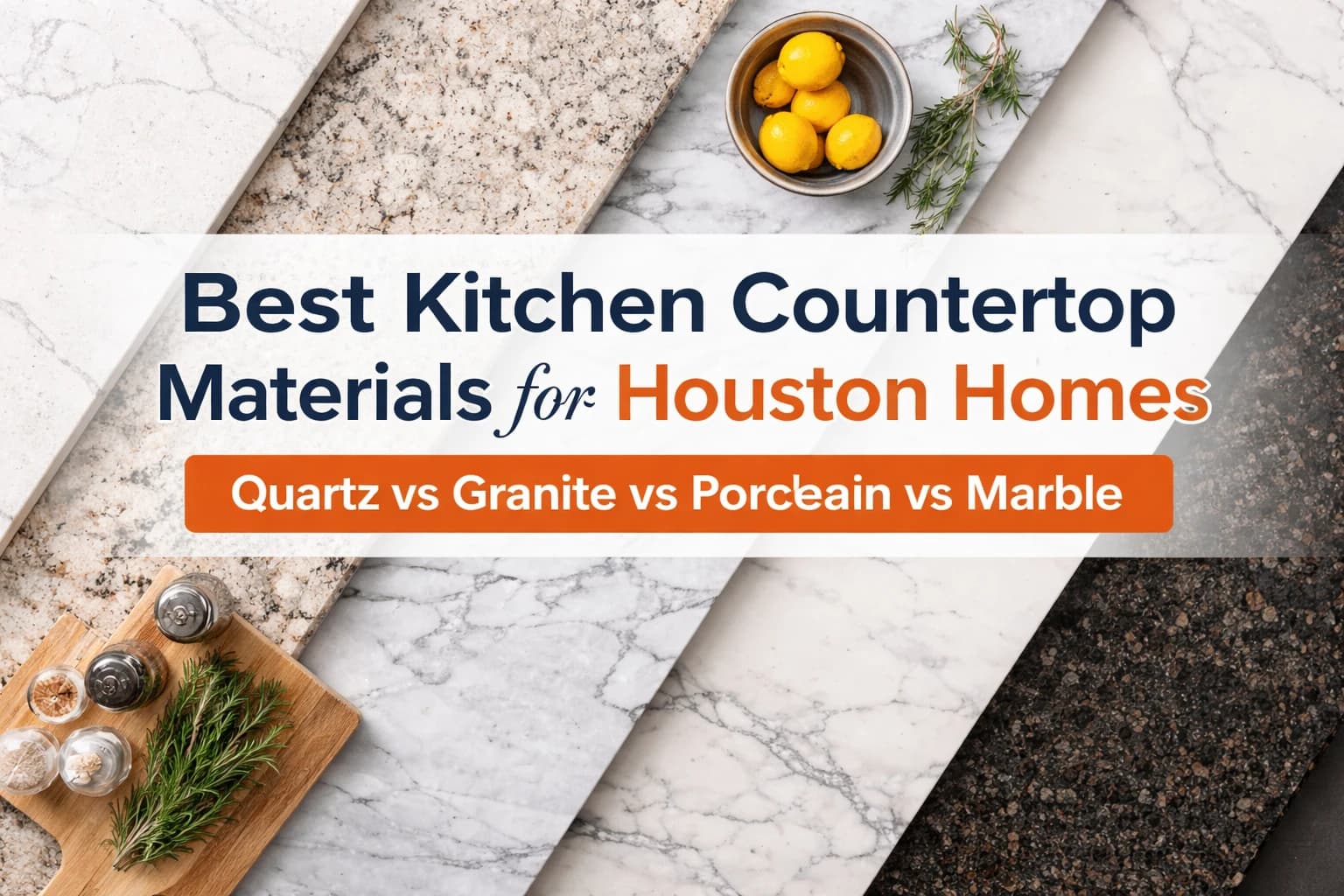
A material-by-material comparison of quartz, granite, porcelain, and marble countertops for Houston kitchens, covering durability, maintenance, look, and what actually holds up to daily cooking.
Of every choice in a kitchen remodel, the countertop is the one you live with most directly. You set hot pans on it, spill coffee on it, lean on it, and look at it every single day. Choose well and the kitchen feels finished and effortless. Choose for the wrong reasons and you spend years working around a surface that fights your habits.
This is a focused comparison of the four materials Houston homeowners ask about most: quartz, granite, porcelain, and marble. We will not get into cabinets or general layout here. If you want to think about how a countertop and cabinet finish work together as a single design, see our companion guide on choosing countertops and cabinets together. This piece stays on the slab itself: how each material wears, what it asks of you, how it looks, and where it fits in a working Houston kitchen.
Quartz: the low-maintenance default
Quartz is an engineered surface, ground natural quartz bound with resin and pigment, which is exactly why it behaves so predictably. The color and pattern you pick is the color and pattern you get across the whole run, with none of the slab-to-slab surprises of natural stone. Because the surface is non-porous, it never needs sealing and shrugs off coffee, wine, and oil with a simple soap-and-water wipe.
The trade-offs are honest ones. Quartz does not love direct, sustained heat: a pan straight off the burner can scorch or discolor the resin, so trivets are non-negotiable for families who cook daily. On long, uninterrupted counters you may see a seam, and very bright, sunny windows can fade some products over many years. For most Houston households that want a beautiful counter without a maintenance routine, quartz is the safe, sensible default.
Granite: real natural stone that earns its keep
Granite is the original natural-stone countertop and still a Houston favorite for good reason. It is genuinely hard, handles heat far better than quartz, and gives you the depth and character that only real stone delivers. Each slab is one of a kind, so the movement and mineral flecks in your kitchen are unrepeatable, which buyers often respond to at resale.
Granite is porous, so it needs periodic sealing to resist staining; how often depends on the density of your specific slab, with some stones needing it far less than others. That same one-of-a-kind nature is a planning consideration: you really should view the full slab in person, because a small sample never tells the whole story of how the pattern will land on your island. If you want true stone, strong heat tolerance, and you do not mind a little upkeep, granite remains a dependable choice.
Porcelain: the modern heat-resistant performer
Porcelain slab is the newest of the four to go mainstream, and it has become a standout for contemporary kitchens. It is fired at extremely high temperatures, which makes it one of the most heat-resistant and stain-resistant surfaces available, and it cleans up as easily as quartz day to day. The printed surface can convincingly mimic marble veining or concrete, so you get a high-end look without the fragility that comes with the real thing.
The catch is fabrication. Porcelain slabs are thinner and harder to cut and miter cleanly, so edges, corners, and waterfall details demand an experienced fabricator and careful planning. That specialization can narrow your options and add cost compared with a common granite. But if your priority is a sleek, modern surface that genuinely laughs at hot cookware, porcelain is one of the strongest performers on this list.
Marble: the luxury look that asks for patience
Marble is the reason luxury kitchens look the way they do. The soft, luminous veining is timeless and impossible to fake perfectly, and nothing else carries quite the same weight of craftsmanship. It is, without question, the most beautiful of the four.
It is also the most demanding. Marble is a calcium-based stone, which means acids found in everyday cooking, lemon juice, vinegar, wine, tomato, can etch the surface, leaving dull marks even when the stone is sealed. It stains more readily than the other options and asks for genuinely careful daily use. Marble rewards the homeowner who loves the look and accepts that the surface will develop a lived-in patina over time. If a flawless, worry-free counter is the goal, marble is the wrong fit; if soul and character matter more, nothing else compares. Homeowners who want the marble aesthetic with far more toughness often land on quartzite, a natural stone that reads similar but resists etching better.
Side-by-side: how the four compare
Put simply, the four materials sort along two axes, how much heat and abuse they take, and how much attention they want from you. Quartz asks the least of you but wants protection from heat. Granite balances real-stone durability and strong heat tolerance against occasional sealing. Porcelain leads on heat and stain resistance but leans on skilled fabrication. Marble leads on pure beauty and asks the most in return.
- Lowest maintenance: Quartz, no sealing, simple wipe-downs.
- Best heat resistance: Porcelain, with granite a strong second.
- Most authentic natural-stone look: Granite, or quartzite for a marble feel.
- Highest-end aesthetic: Marble, with realistic expectations about etching.
- Most stain-resistant overall: Porcelain and quartz, both non-porous.
On cost, treat any number you read online as a broad guide only, because real pricing swings with the specific slab, its rarity, thickness, edge profile, and how much fabrication your layout demands. As a general pattern, quality laminate or solid surface sits at the affordable end, mid-range quartz and granite occupy the broad middle, and exotic marble, premium quartzite, and intricate porcelain work tend to run higher. We give a real, slab-specific number once we have seen your kitchen rather than guessing from a chart.
How to choose for your Houston kitchen
The right material is the one that matches how you actually use your kitchen, not the one that photographs best. Start with your cooking habits: if you cook hard and often, weight heat and stain resistance heavily, which pushes you toward porcelain, granite, or quartz with disciplined trivet use. If a maintenance routine is a dealbreaker, quartz removes sealing from your life entirely.
Then weigh look and resale. Neutral quartz, well-chosen granite, and porcelain slabs appeal to the widest range of buyers and tend to age gracefully, while bolder marble is a personal statement that suits homeowners staying put. Finally, view your actual slab before committing, especially with any natural stone, so the pattern that lands on your island is the one you fell in love with. If you want a second set of eyes on the decision, our kitchen remodeling team helps homeowners weigh durability, maintenance, and budget against the way they really live. When new countertops are part of a wider home remodeling project, we coordinate the surfaces with everything around them. You can see how these materials read in finished rooms on our project gallery, and homeowners across the area, including those planning a remodel in Sugar Land, work through the same trade-offs with us.