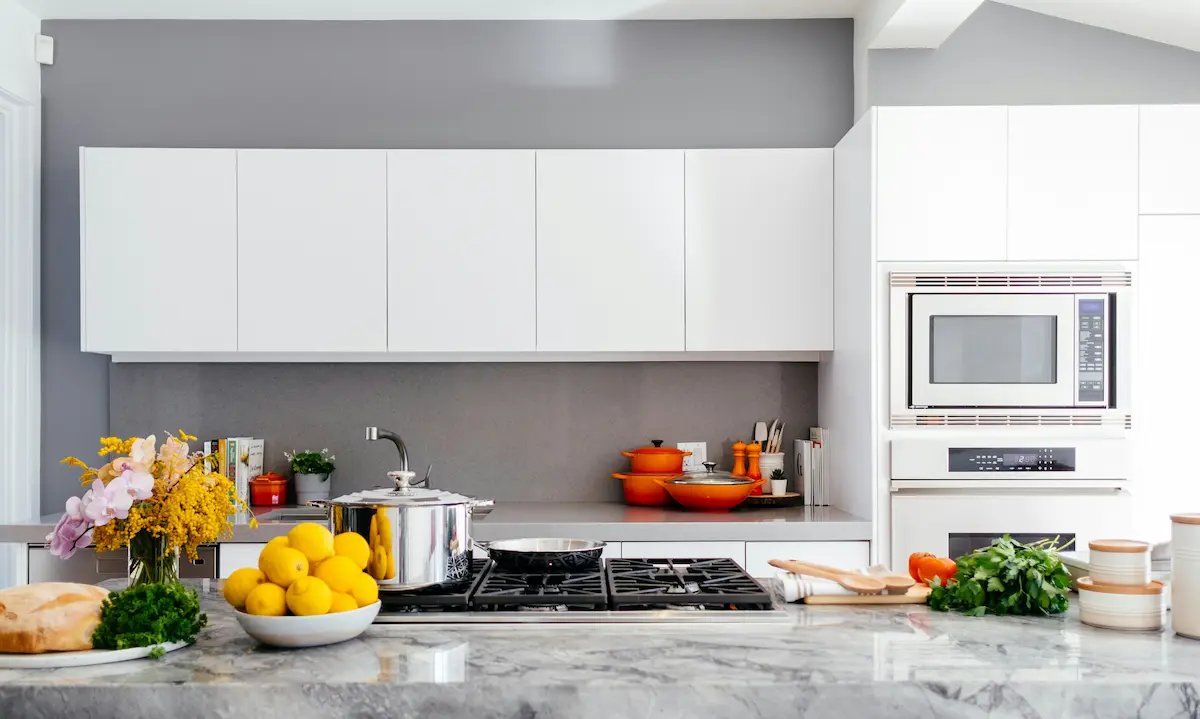
Countertops and cabinets are not two separate purchases. They are one design decision. Here is how to coordinate color, finish, cabinet style, and layout so your Houston kitchen feels intentional rather than assembled from samples.
Most kitchen remodels go sideways at the same moment: the homeowner falls in love with a countertop slab, orders it, and only then starts thinking about cabinets. By the time the cabinet samples arrive, the surface is already locked, and every door color has to bend to a decision made in isolation. The result is a kitchen that technically works but never quite feels resolved.
The better way to think about it is simple. Your countertops and your cabinets are not two purchases. They are one design decision with two halves. When you choose them together, the eye reads the room as intentional. When you choose them apart, the seams show. This guide is about coordinating the two so your Houston kitchen feels considered from the first glance, and it pairs with our deep dive on kitchen countertop materials if you want to go slab-by-slab on the surface itself.
Coordinating Color and Finish So Nothing Fights
The fastest way to a cohesive kitchen is to decide which element leads and which element supports. A surface with strong, dramatic veining wants quiet cabinetry around it, so a busy stone reads as the centerpiece rather than competing with painted doors. A calm, near-solid countertop gives you room to push color on the cabinets, which is where deep navy, soft greige, or a warm wood island can carry the room.
Finish matters as much as color, and it is the detail most homeowners overlook. A high-gloss painted door beside a high-gloss polished slab can feel slick and clinical, while pairing a honed or matte surface with a satin cabinet finish reads warmer and more livable. Mixing one of each, such as a honed countertop against a smooth painted door, adds quiet depth without anyone being able to name exactly why the room feels good. Pull a single thread of contrast through both, often the metal of the hardware and faucet, so matte black or aged brass ties the two halves together rather than leaving them as separate ideas.
Undertone is the silent decider. Many Houston kitchens look slightly off because a cool gray cabinet sits beneath a stone with warm beige veining, and the two undertones never reconcile. Bring your largest cabinet sample and your actual slab into the same room, in daylight, and stand them side by side before anything is ordered. If the undertones argue under your own lighting, no amount of styling will fix it later.
Cabinet Style, Storage, and How the Surface Sits on Top
Cabinet style sets the architecture that your countertop then completes. Shaker doors remain the most forgiving choice in Houston because their recessed panel reads as transitional, sitting comfortably under nearly any surface from a quiet quartz to a richly figured stone. Flat-panel doors lean modern and pair best with clean, uniform tops and waterfall edges, where the surface wraps down the side of an island as a continuous plane. Heavily detailed or inset cabinetry, by contrast, wants a more restrained countertop so the room does not tip into visual noise.
Storage is where the pairing becomes practical rather than purely visual. Deep drawers with adjustable dividers, pull-out pantries, a hidden trash center, and corner organizers all change how the countertop above them gets used day to day. An appliance garage tucked at the back of the counter keeps the surface clear, which matters most on the prep zone where a busy stone can otherwise feel cluttered. Plan the storage and the countertop run together, because the cabinet boxes determine where your seams, your prep space, and your landing zones actually fall.
Edge profile is the small hinge between the two halves. A thick, squared edge underlines a modern flat-panel kitchen, while a softer eased or beveled edge suits shaker doors and traditional rooms. It is a five-minute decision that quietly signals whether the whole kitchen leans contemporary or classic, so make it on purpose rather than defaulting to the fabricator's standard.
Layout, Workflow, and Daily Durability
Coordination is not only about how the kitchen looks standing still. It is about how it works while you cook. The classic work triangle between sink, range, and refrigerator still holds, and your cabinet layout is what protects it. If an island grows large enough to force a long detour between the cooktop and the sink, the room photographs beautifully and frustrates you nightly. Size the island to the surface it carries and to the path you actually walk.
Match the surface to the zone it serves. The hardest-working stretches, around the range and the main prep area, deserve the most durable, lowest-maintenance material you are willing to buy, while a baking station or a coffee corner can carry a softer or more characterful surface that sees gentler use. Houston's humidity is the quiet factor underneath all of it: a non-porous top paired with well-sealed or moisture-resistant cabinet boxes simply ages better here than porous surfaces over particleboard that can swell over time. Durability is a pairing decision too, because the most resilient counter loses its value if it sits on cabinetry that cannot keep up.
Putting the Two Halves Together
When it all lands, the test is whether the eye can rest. Light surfaces over dark cabinets read crisp and graphic; warm wood tones beside a pale top feel calm and Scandinavian; a two-tone scheme with deeper lowers and lighter uppers can define zones in an open plan without a single wall. None of these are right or wrong. What matters is that the countertop and the cabinets were chosen for each other rather than collected separately and reconciled at the end.
This is the part where an owner-led remodeler earns the engagement, because coordinating two large decisions in real time, against your home's light and your daily routine, is the whole job. Our kitchen remodeling work centers on exactly this kind of paired decision-making, and you can see how it carries through full projects in our whole-home renovations and across The Heights and nearby neighborhoods. When you are ready to sit down with the samples in one place, reach out and we will plan the pairing before anything is ordered.